Skip to content
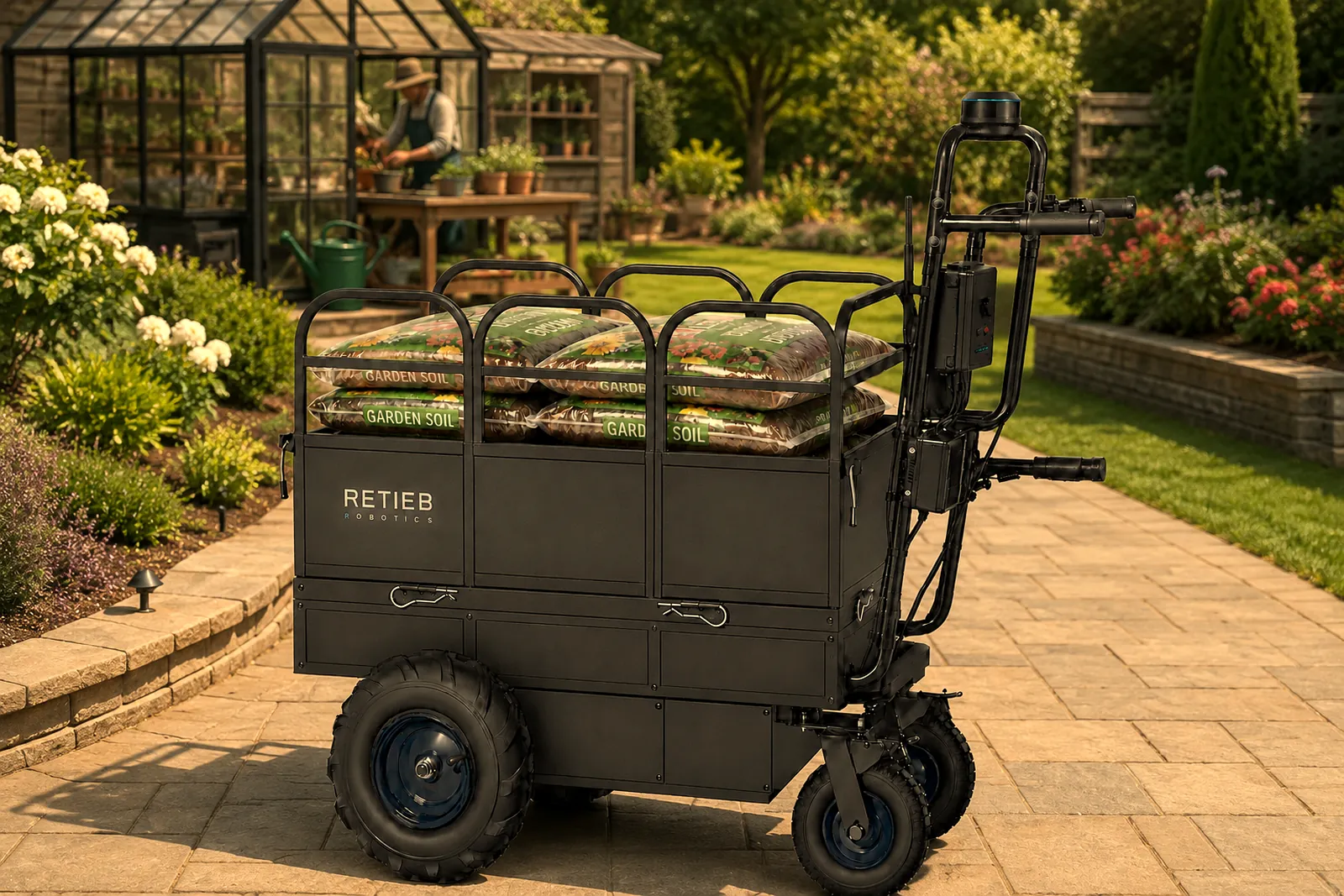
Concept visualisation of the ERDEN Utility platform — an electric utility cart carrying garden soil along a stone walkway
Concept vision

Target platform. The vehicle below is factory-standard and under baseline characterisation — no conversion work has started.

ERDEN program · Ground platform 02

ERDEN Utility

Carry.Haul.Work.

A load-carrying work platform being developed from a factory electric utility vehicle: moving material, hauling equipment, and eventually carrying out repetitive physical work around a property without a person walking alongside it.

Engineering snapshot

Sourced from platform metadata and the engineering log — it changes as the work does.

Platform
VEVOR 4-wheel electric utility cart
Development chassis
Development state
Concept research
Current focus
Baseline characterisation
Research
Current challenge
Factory motor control interface is unknown
Research
Next milestone
Factory baseline characterised
Next
Last updated
8 Aug 2026
From the engineering log
Engineering log
2
Entries published
Related hardware
9
Components documented
Related modules
10
Capability packages
Log entries
2
Decisions
5
Modules
10
Characterization
1

Platform brief

Derived by traversing the knowledge graph: objective, milestones, active areas, blockers, decisions, and risks. Nothing on this panel is written by hand.

Platform brief

Concept · Research

Move material and eventually carry out repetitive work around a property without a person walking alongside it. Utility exists to take on the physical, load-bearing tasks that Scout is deliberately too small to touch.

Current objective
ERDEN Utility

ERDEN program · Ground platform 02

Current milestone
Factory baseline characterised

Next

Next milestone
Control and safety architecture defined

Later

Next recommended
Advance Mechanical beyond research

It is the least-advanced subsystem, and platform readiness is bounded by its weakest part.

Open blockers
6
Outstanding decisions
5

Current risks

1 derived

Engineering review

A full review assembled from the graph: readiness, risk, milestone progress, period-over-period change, and recommended next actions. Every conclusion cites the records it was derived from.

Executive summary

ERDEN Utility

ERDEN Utility is concept with overall readiness at early. 6 challenges remain open while the platform works towards "Factory baseline characterised".

  • Readiness is limited by hardware readiness, module readiness, integration readiness, decision completeness.
  • 9 hardware records, 10 modules, and 5 decisions are referenced.
  • 2 log entries provide the timestamped evidence behind this review.
  • 1 risk condition and 27 validation findings are present in scope.
Evidence
Evidence not in the graph
  • No milestone on this platform is marked complete yet.
  • Some milestones carry coarse periods rather than dates, so they are excluded from time windows.
  • Every statement is derived from the current registries; nothing in this summary is authored.

Review sections

8 derived

Current objective

Move material and eventually carry out repetitive work around a property without a person walking alongside it. Utility exists to take on the physical, load-bearing tasks that Scout is deliberately too small to touch.

  • The platform record is concept.
  • Baseline characterisation and architecture definition. The base vehicle is factory-standard and no conversion work has begun. Drive controller signalling, braking fail-state, steering geometry, and the electrical system are all unmeasured, and no compute, sensing, or actuation hardware has been selected. Every specification below is vendor-published unless stated otherwise.
Evidence

Active work

3 engineering areas are open on this platform.

  • Baseline characterisation — Research.
  • Control architecture definition — Research.
  • Safety architecture for a heavy platform — Research.

Hardware status

9 hardware records referenced; readiness is early.

  • 9 concept.
VEVOR 4-wheel electric utility cart500 W brushless drive systemOEM motor controllerOEM accelerator controlOEM forward / reverse selectorOEM electronic brakeOEM battery system13 in pneumatic wheel and tyre setFlatbed cargo deck
Evidence
  • HardwareVEVOR 4-wheel electric utility cartChassis · VEVOR
  • Hardware500 W brushless drive systemDrive · VEVOR (OEM)
  • HardwareOEM motor controllerControl · VEVOR (OEM)
  • HardwareOEM accelerator controlControl · VEVOR (OEM)
  • HardwareOEM forward / reverse selectorControl · VEVOR (OEM)
  • HardwareOEM electronic brakeControl · VEVOR (OEM)
  • HardwareOEM battery systemPower · VEVOR (OEM)
  • Hardware13 in pneumatic wheel and tyre setDrive · VEVOR (OEM)
  • HardwareFlatbed cargo deckPayload · VEVOR (OEM)

Module status

10 modules mounted or declared compatible; least-advanced state is planning.

  • Utility drive control: concept · research.
  • Utility steering control: concept · research.
  • Utility braking and stop path: concept · research.
  • Utility power system: concept · research.
  • Utility compute: concept · research.
  • Utility communications and teleoperation link: concept · research.
  • Utility localisation: concept · research.
  • Utility safety architecture: concept · research.
  • Utility autonomous navigation: concept · research.
  • Payload interface: concept · planning.
Evidence

Decision status

3 of 5 decisions are accepted; 5 remain open.

  • Start ERDEN Utility from a commercial electric utility vehicle: accepted, no outcome recorded.
  • Keep Utility a work platform, distinct from Scout: accepted, no outcome recorded.
  • Characterise the factory vehicle before any conversion work: accepted, no outcome recorded.
  • Autonomy work on Utility waits behind a demonstrated safety architecture: proposed, no outcome recorded.
  • Define a standardised payload and implement interface for Utility: proposed, no outcome recorded.
Evidence
Evidence not in the graph
  • Start ERDEN Utility from a commercial electric utility vehicle has no recorded outcome.
  • Keep Utility a work platform, distinct from Scout has no recorded outcome.
  • Characterise the factory vehicle before any conversion work has no recorded outcome.
  • Autonomy work on Utility waits behind a demonstrated safety architecture has no recorded outcome.
  • Define a standardised payload and implement interface for Utility has no recorded outcome.

Integration review

0 of 12 subsystems are operational.

  • 12 subsystems are tracked on the platform record.
  • Weakest subsystem: Mechanical.
  • 0 of 12 subsystems are operational.
Evidence
  • SubsystemMechanical: ResearchFactory chassis, deck, and wheels as delivered. Frame geometry, mass distribution, and mounting provisions are uncharacterised.
  • SubsystemDrive: Research500 W brushless drive under factory control. No commanded interface exists and the controller signalling has not been measured.
  • SubsystemSteering: ResearchMechanical steering with no actuation path. Geometry, effort, and travel unmeasured; no actuation approach selected.
  • SubsystemBraking: ResearchFactory electronic brake. Behaviour on power loss, on controller fault, and under command is unknown, as is slope holding under payload.
  • SubsystemElectrical: ResearchPack chemistry, voltage, capacity, charging behaviour, and auxiliary rail availability are all unmeasured. No power budget exists.
  • SubsystemCompute: ResearchNo compute hardware selected. Selection follows the power and control-architecture answers rather than preceding them.
  • SubsystemCommunications: ResearchNo operator link, telemetry path, or remote stop. Expected to reuse Scout's independent-stop boundary, but nothing is specified.
  • SubsystemLocalisation: ResearchNo wheel feedback or position sensing fitted. Pneumatic tyres make rolling radius a measured quantity rather than a constant.
  • SubsystemPerception: ResearchNothing fitted. Sensing requirements follow from the operating envelope, which has not been defined.
  • SubsystemSafety: ResearchNo emergency stop, fail-safe state definition, or speed limiting. This subsystem gates every motion test on the platform.
  • SubsystemAutonomy: ResearchDeliberately untouched. It depends on drive, steering, braking, safety, and localisation all being real first.
  • SubsystemPayload interface: ResearchFlatbed deck with no mounting pattern, power, or data provision. A standardised interface has not been written.
  • HardwareVEVOR 4-wheel electric utility cartChassis · VEVOR
  • Hardware500 W brushless drive systemDrive · VEVOR (OEM)
  • HardwareOEM motor controllerControl · VEVOR (OEM)
  • HardwareOEM accelerator controlControl · VEVOR (OEM)
  • HardwareOEM forward / reverse selectorControl · VEVOR (OEM)
  • HardwareOEM electronic brakeControl · VEVOR (OEM)
  • HardwareOEM battery systemPower · VEVOR (OEM)
  • Hardware13 in pneumatic wheel and tyre setDrive · VEVOR (OEM)
  • HardwareFlatbed cargo deckPayload · VEVOR (OEM)
  • ModuleUtility drive controlResearch
  • ModuleUtility steering controlResearch
  • ModuleUtility braking and stop pathResearch
  • ModuleUtility power systemResearch
  • ModuleUtility computeResearch
  • ModuleUtility communications and teleoperation linkResearch
  • ModuleUtility localisationResearch
  • ModuleUtility safety architectureResearch
  • ModuleUtility autonomous navigationResearch
  • ModulePayload interfacePlanning

Open blockers

6 challenges referencing this platform are not complete.

  • Factory motor control interface is unknown: concept · research.
  • Steering architecture is undefined: concept · research.
  • Braking behaviour and fail-state are uncharacterised: concept · research.
  • Electrical baseline is unmeasured: concept · research.
  • Safety architecture for a heavy platform is unspecified: concept · research.
  • Payload and implement interface is undefined: concept · research.
Evidence

Recent engineering activity

2 log entries recorded; newest is 2026-08-08.

  • 2026-08-08 — ERDEN Utility platform selection (Process).
  • 2026-08-08 — Baseline characterization procedure written (Process).
Evidence

Milestone review

0 complete

Working towards "Factory baseline characterised"; 0 of 3 milestones are complete.

Current milestone
Factory baseline characterised

Next

Next milestone
Control and safety architecture defined

Later

Next recommended
Advance Mechanical beyond research

It is the least-advanced subsystem, and platform readiness is bounded by its weakest part.

Completed0

No milestone is complete yet.

Open3
Factory baseline characterisedControl and safety architecture definedFirst supervised commanded motion
Evidence
  • MilestoneFactory baseline characterisedCurrent milestone
  • MilestoneControl and safety architecture definedNext milestone
Evidence not in the graph
  • No milestone on this platform is marked complete yet.
  • Some milestones carry coarse periods rather than dates, so they are excluded from time windows.

Readiness review

Early overall

Overall readiness is early.

  • Overall readiness is limited by the weakest supported dimension: Hardware readiness, Module readiness, Integration readiness, Decision completeness.
  • 5 of 5 dimensions have supporting records in the graph.
  • The limiting dimensions are hardware readiness, module readiness, integration readiness, decision completeness.
Evidence
  • HardwareHardware readiness: Early9 hardware records referenced by this platform.
  • ModuleModule readiness: Early10 modules are mounted or declared compatible.
  • SubsystemIntegration readiness: Early12 subsystems are tracked on the platform record.
  • PlatformDocumentation completeness: Ready19 of 19 referenced hardware and module records carry a description and supporting detail (100%).
  • DecisionDecision completeness: Early0 of 5 recorded decisions are accepted with a documented outcome.
  • Readiness is a position on an ordered ladder derived from record states, not a percentage or an estimate.
Hardware readinessEarly
  • 9 hardware records referenced by this platform.
  • Weakest lifecycle status: Concept.
VEVOR 4-wheel electric utility cart500 W brushless drive systemOEM motor controllerOEM accelerator controlOEM forward / reverse selectorOEM electronic brake
Module readinessEarly
  • 10 modules are mounted or declared compatible.
  • Least-advanced module state: Research.
Integration readinessEarly
  • 12 subsystems are tracked on the platform record.
  • Weakest subsystem: Mechanical.
  • 0 of 12 subsystems are operational.
Documentation completenessReady
  • 19 of 19 referenced hardware and module records carry a description and supporting detail (100%).
  • No platform-level documents are attached yet.
Decision completenessEarly
  • 0 of 5 recorded decisions are accepted with a documented outcome.
  • 2 decisions are still open.
  • 6 open challenges may still force a decision.

Risk review

1 derived

1 risk condition derived from the graph, alongside 27 validation findings in scope.

Validation findings in scope27
  • infoNo datasheet or vendor documentation linked.VEVOR 4-wheel electric utility cart
  • infoNo datasheet or vendor documentation linked.500 W brushless drive system
  • infoNo datasheet or vendor documentation linked.13 in pneumatic wheel and tyre set
  • infoNo datasheet or vendor documentation linked.Flatbed cargo deck
  • infoNo datasheet or vendor documentation linked.OEM battery system
  • infoNo datasheet or vendor documentation linked.OEM motor controller
  • infoNo datasheet or vendor documentation linked.OEM accelerator control
  • infoNo datasheet or vendor documentation linked.OEM forward / reverse selector
  • infoNo datasheet or vendor documentation linked.OEM electronic brake
  • infoPhase delivers no module.Sustained field operation

Change summary

9 Jul 2026 – 8 Aug 2026

Compared against the preceding 30-day window (2026-06-09 to 2026-07-09). Dates come from the engineering log and the decision registry; records without dates are excluded.

Engineering log entries
2+2from 0
Work completed
00from 0
Decisions recorded
00from 0
Hardware first referenced
7+7from 0

Dated by first appearance in the log.

Modules first referenced
00from 0

Dated by first appearance in the log.

Blockers active
5+5from 0
Blockers resolved
00from 0
Work completed0

Nothing closed in this window.

Hardware first referenced7
VEVOR 4-wheel electric utility cart500 W brushless drive systemOEM battery systemOEM motor controllerOEM accelerator controlOEM forward / reverse selectorOEM electronic brake
Modules first referenced0

No module appeared for the first time.

Decisions recorded0

No decision was recorded in this window.

Readiness is derived from current record states. The graph stores no history of those states, so a readiness delta cannot be computed without inventing one.

Recommended next actions

4 derived
  1. mediumClose 6 open challenges
    Reason

    Open challenges are the platform's declared unknowns; each one holds work behind it.

    Triggered by

    6 challenges referencing this platform are not yet complete.

    Expected impact

    Reduces the platform's open-question surface and frees the linked engineering areas to progress.

    Supporting evidence
  2. mediumSettle 5 outstanding decisions
    Reason

    Decisions that are proposed, revisiting, or missing an outcome leave dependent hardware and modules provisional.

    Triggered by

    5 decisions linked to this platform are unresolved in the decision registry.

    Expected impact

    Improves decision completeness, which is one of the five readiness dimensions.

    Supporting evidence
  3. mediumAdvance Mechanical beyond research
    Reason

    It is the least-advanced subsystem, and platform readiness is bounded by its weakest part.

    Triggered by

    Derived by the platform brief from milestone, roadmap, subsystem, and blocker state.

    Expected impact

    Advances the earliest incomplete commitment the platform record holds.

  4. lowReplace 10 provisional records with measured detail
    Reason

    Provisional records carry part of the platform definition without confirmed data behind them.

    Triggered by

    Records marked provisional in the registries are carrying part of this platform's definition.

    Expected impact

    Removes provisional flags from the definition and strengthens documentation completeness.

    Supporting evidence

Milestone gate

The highest gate stage whose conditions currently hold, with every evaluated condition and the records behind it.

Milestone gate — ERDEN Utility

Ready for review

Ready for review passes because Mission and current status are recorded on the platform. 9 hardware records referenced. 2 log entries reference this platform. No validation error is reported in scope.

Next gate — Ready for integration3
  • Baseline characterization evidence is complete — No finding has been inspected yet. 11 evidence areas are required before drive-by-wire architecture can be argued.
  • Hardware readiness has reached developing — Hardware readiness is early.
  • Every referenced decision is settled with an outcome — 5 decisions are proposed, revisiting, or missing an outcome.
Evaluated stages4
Ready for reviewPassed
  • The platform record states a mission and current statusMission and current status are recorded on the platform.ERDEN Utility
  • At least one hardware record is referenced9 hardware records referenced.
  • Engineering activity is recorded in the log2 log entries reference this platform.
  • No validation errors in scopeNo validation error is reported in scope.
Ready for integrationNot met
Ready for testingNot met
Ready for releaseNot met
  • Every subsystem is at testing or operational0 of 12 subsystems are at testing or operational.
  • Overall readiness is validating or readyOverall readiness is early, limited by Overall readiness.
  • Every recorded milestone is complete0 of 3 milestones are complete.
  • No validation errors or warnings in scope0 errors and 0 warnings in scope.
  • Documentation readiness has reached validatingDocumentation readiness is ready.
Gate evidence
  • PlatformERDEN UtilityLifecycle status: Concept
  • SubsystemMechanical: ResearchFactory chassis, deck, and wheels as delivered. Frame geometry, mass distribution, and mounting provisions are uncharacterised.
  • SubsystemDrive: Research500 W brushless drive under factory control. No commanded interface exists and the controller signalling has not been measured.
  • SubsystemSteering: ResearchMechanical steering with no actuation path. Geometry, effort, and travel unmeasured; no actuation approach selected.
  • SubsystemBraking: ResearchFactory electronic brake. Behaviour on power loss, on controller fault, and under command is unknown, as is slope holding under payload.
  • SubsystemElectrical: ResearchPack chemistry, voltage, capacity, charging behaviour, and auxiliary rail availability are all unmeasured. No power budget exists.
  • SubsystemCompute: ResearchNo compute hardware selected. Selection follows the power and control-architecture answers rather than preceding them.
  • SubsystemCommunications: ResearchNo operator link, telemetry path, or remote stop. Expected to reuse Scout's independent-stop boundary, but nothing is specified.
  • SubsystemLocalisation: ResearchNo wheel feedback or position sensing fitted. Pneumatic tyres make rolling radius a measured quantity rather than a constant.
  • SubsystemPerception: ResearchNothing fitted. Sensing requirements follow from the operating envelope, which has not been defined.
  • SubsystemSafety: ResearchNo emergency stop, fail-safe state definition, or speed limiting. This subsystem gates every motion test on the platform.
  • SubsystemAutonomy: ResearchDeliberately untouched. It depends on drive, steering, braking, safety, and localisation all being real first.
  • SubsystemPayload interface: ResearchFlatbed deck with no mounting pattern, power, or data provision. A standardised interface has not been written.
  • ChallengeFactory motor control interface is unknownOpen: Factory motor control interface is unknownConcept · Research
  • ChallengeSteering architecture is undefinedOpen: Steering architecture is undefinedConcept · Research
  • ChallengeBraking behaviour and fail-state are uncharacterisedOpen: Braking behaviour and fail-state are uncharacterisedConcept · Research
  • ChallengeElectrical baseline is unmeasuredOpen: Electrical baseline is unmeasuredConcept · Research
  • ChallengeSafety architecture for a heavy platform is unspecifiedOpen: Safety architecture for a heavy platform is unspecifiedConcept · Research
  • ChallengePayload and implement interface is undefinedOpen: Payload and implement interface is undefinedConcept · Research
  • DecisionStart ERDEN Utility from a commercial electric utility vehicleUnsettled: Start ERDEN Utility from a commercial electric utility vehicleAccepted · 2026
  • DecisionKeep Utility a work platform, distinct from ScoutUnsettled: Keep Utility a work platform, distinct from ScoutAccepted · 2026
  • DecisionCharacterise the factory vehicle before any conversion workUnsettled: Characterise the factory vehicle before any conversion workAccepted · 2026
  • DecisionAutonomy work on Utility waits behind a demonstrated safety architectureUnsettled: Autonomy work on Utility waits behind a demonstrated safety architectureProposed · 2026
  • DecisionDefine a standardised payload and implement interface for UtilityUnsettled: Define a standardised payload and implement interface for UtilityProposed · 2027

Engineering checklist

Live graph conditions. There is no completion state: satisfying a condition removes its item.

Engineering checklist — ERDEN Utility

37 open · 6 blocking

37 conditions are currently true in the graph across 5 areas; 6 of them block a gate.

High
0
Medium
21
Low
16
Blocking
6

gate conditions

Outstanding blockers6
  • mediumBlockingBraking behaviour and fail-state are uncharacterised

    The challenge is concept at research and references this platform.

    Clears when: The challenge record's status becomes complete.

  • mediumBlockingElectrical baseline is unmeasured

    The challenge is concept at research and references this platform.

    Clears when: The challenge record's status becomes complete.

  • mediumBlockingFactory motor control interface is unknown

    The challenge is concept at research and references this platform.

    Clears when: The challenge record's status becomes complete.

  • mediumBlockingPayload and implement interface is undefined

    The challenge is concept at research and references this platform.

    Clears when: The challenge record's status becomes complete.

  • mediumBlockingSafety architecture for a heavy platform is unspecified

    The challenge is concept at research and references this platform.

    Clears when: The challenge record's status becomes complete.

  • mediumBlockingSteering architecture is undefined

    The challenge is concept at research and references this platform.

    Clears when: The challenge record's status becomes complete.

Missing dependencies4
  • mediumUtility autonomous navigation declares no hardware dependency

    The module record carries no hardwareIds, so nothing in the graph states what it physically needs.

    Clears when: The module references at least one hardware record.

  • mediumUtility communications and teleoperation link declares no hardware dependency

    The module record carries no hardwareIds, so nothing in the graph states what it physically needs.

    Clears when: The module references at least one hardware record.

  • mediumUtility compute declares no hardware dependency

    The module record carries no hardwareIds, so nothing in the graph states what it physically needs.

    Clears when: The module references at least one hardware record.

  • lowFlatbed cargo deck is not claimed by any module

    No module in the registry references this hardware record, so its purpose is not expressed as a relationship.

    Clears when: A module lists this hardware id, or the hardware record reaches complete.

    Flatbed cargo deck
Incomplete modules10
  • mediumPayload interface is at planning

    The module record's engineering state is planning and its lifecycle status is concept.

    Clears when: The module record's engineering state reaches operational.

    Payload interface
  • mediumUtility autonomous navigation is at research

    The module record's engineering state is research and its lifecycle status is concept.

    Clears when: The module record's engineering state reaches operational.

  • mediumUtility braking and stop path is at research

    The module record's engineering state is research and its lifecycle status is concept.

    Clears when: The module record's engineering state reaches operational.

  • mediumUtility communications and teleoperation link is at research

    The module record's engineering state is research and its lifecycle status is concept.

    Clears when: The module record's engineering state reaches operational.

  • mediumUtility compute is at research

    The module record's engineering state is research and its lifecycle status is concept.

    Clears when: The module record's engineering state reaches operational.

  • mediumUtility drive control is at research

    The module record's engineering state is research and its lifecycle status is concept.

    Clears when: The module record's engineering state reaches operational.

  • mediumUtility localisation is at research

    The module record's engineering state is research and its lifecycle status is concept.

    Clears when: The module record's engineering state reaches operational.

  • mediumUtility power system is at research

    The module record's engineering state is research and its lifecycle status is concept.

    Clears when: The module record's engineering state reaches operational.

  • mediumUtility safety architecture is at research

    The module record's engineering state is research and its lifecycle status is concept.

    Clears when: The module record's engineering state reaches operational.

  • mediumUtility steering control is at research

    The module record's engineering state is research and its lifecycle status is concept.

    Clears when: The module record's engineering state reaches operational.

Required decisions5
  • mediumAutonomy work on Utility waits behind a demonstrated safety architecture is proposed

    The decision registry holds this decision in a non-final status, so everything downstream of it remains provisional.

    Clears when: The decision status becomes accepted or superseded.

  • mediumDefine a standardised payload and implement interface for Utility is proposed

    The decision registry holds this decision in a non-final status, so everything downstream of it remains provisional.

    Clears when: The decision status becomes accepted or superseded.

  • lowCharacterise the factory vehicle before any conversion work has no recorded outcome

    The decision is settled but the record carries no outcome, so its consequence is not in the graph.

    Clears when: An outcome is recorded on the decision.

  • lowKeep Utility a work platform, distinct from Scout has no recorded outcome

    The decision is settled but the record carries no outcome, so its consequence is not in the graph.

    Clears when: An outcome is recorded on the decision.

    Keep Utility a work platform, distinct from Scout
  • lowStart ERDEN Utility from a commercial electric utility vehicle has no recorded outcome

    The decision is settled but the record carries no outcome, so its consequence is not in the graph.

    Clears when: An outcome is recorded on the decision.

Missing documentation12
  • lowDefine a standardised payload and implement interface for Utility is marked provisional

    The record carries a placeholder flag, so part of the platform definition has no confirmed data behind it.

    Clears when: The placeholder flag is removed once measured detail replaces it.

  • lowPayload interface is marked provisional

    The record carries a placeholder flag, so part of the platform definition has no confirmed data behind it.

    Clears when: The placeholder flag is removed once measured detail replaces it.

  • lowThe platform record links no documentation

    No documentation links are recorded on the platform, so reviews have nothing external to cite.

    Clears when: At least one documentation link is recorded on the platform.

  • lowUtility autonomous navigation is marked provisional

    The record carries a placeholder flag, so part of the platform definition has no confirmed data behind it.

    Clears when: The placeholder flag is removed once measured detail replaces it.

  • lowUtility braking and stop path is marked provisional

    The record carries a placeholder flag, so part of the platform definition has no confirmed data behind it.

    Clears when: The placeholder flag is removed once measured detail replaces it.

  • lowUtility communications and teleoperation link is marked provisional

    The record carries a placeholder flag, so part of the platform definition has no confirmed data behind it.

    Clears when: The placeholder flag is removed once measured detail replaces it.

  • lowUtility compute is marked provisional

    The record carries a placeholder flag, so part of the platform definition has no confirmed data behind it.

    Clears when: The placeholder flag is removed once measured detail replaces it.

  • lowUtility drive control is marked provisional

    The record carries a placeholder flag, so part of the platform definition has no confirmed data behind it.

    Clears when: The placeholder flag is removed once measured detail replaces it.

  • lowUtility localisation is marked provisional

    The record carries a placeholder flag, so part of the platform definition has no confirmed data behind it.

    Clears when: The placeholder flag is removed once measured detail replaces it.

  • lowUtility power system is marked provisional

    The record carries a placeholder flag, so part of the platform definition has no confirmed data behind it.

    Clears when: The placeholder flag is removed once measured detail replaces it.

  • lowUtility safety architecture is marked provisional

    The record carries a placeholder flag, so part of the platform definition has no confirmed data behind it.

    Clears when: The placeholder flag is removed once measured detail replaces it.

  • lowUtility steering control is marked provisional

    The record carries a placeholder flag, so part of the platform definition has no confirmed data behind it.

    Clears when: The placeholder flag is removed once measured detail replaces it.

Baseline characterization

The Phase 1 inspection procedure and its derived completion gate. Vendor figures stay vendor figures until a physical observation replaces them.

Phase 1 completion gate — baseline characterization

0/119 findings · Characterization not started

No finding has been inspected yet. 11 evidence areas are required before drive-by-wire architecture can be argued.

Gate
Characterization not started

Phase 1 remains open

Evidence areas met
0/11

Required before Phase 2

Findings satisfied
0/119

Across every section

Requires follow-up
0

Return visits or better tooling

Recorded unknowns
0

A recorded result, not a failure

Vendor/observation discrepancies
0

Both values preserved

Required evidence11
  • Battery architecture0/6 evidence

    Every compute, sensing, and actuation power budget starts from the pack. Without chemistry, voltage, capacity, protection, and a measured resting voltage, an auxiliary power architecture cannot be specified.

    Missing: Battery chemistry · Nominal voltage · Capacity · Main fuse / breaker and wire gauge · Resting pack voltage · Charger specification

  • Motor identification0/4 evidence

    Drive-by-wire cannot be scoped without knowing what the motor is, how it is driven, and how it is mounted.

    Missing: Motor identification plate · Drive-wheel arrangement · Motor location · Motor connections

  • Motor-controller identification0/4 evidence

    The controller decides whether the drive is commanded, intercepted, or replaced. That choice needs the controller's identity and its connector set.

    Missing: Motor controller identification · Motor controller · Battery input to controller · Known vs unknown purpose

  • Accelerator / control interface0/4 evidence

    The accelerator is the most likely interception point. Its type, wiring, and connector must be documented before any approach is proposed.

    Missing: Accelerator / throttle · Conductor / pin counts · Wire colours · Connector locations

  • Direction-control interface0/2 evidence

    Direction selection is a separate command path from speed, and its factory behaviour constrains what a commanded system is allowed to do.

    Missing: Forward / reverse selector · Forward / reverse switching

  • Braking behaviour0/4 evidence

    The stop path is the foundation of the safety architecture. A documented "unknown mechanism" is acceptable; an untested one is not.

    Missing: Normal stopping behaviour · Behaviour on accelerator release · Behaviour when power is switched off · Braking mechanism conclusion

  • Steering architecture0/5 evidence

    Actuation cannot be sized without the mechanism, travel, and geometry it must drive.

    Missing: Which wheels steer · Steering mechanism · Steering travel · Approximate maximum wheel angle · Linkages and tie rods

  • Basic mechanical dimensions0/7 evidence

    Mounting, clearance, payload, and localisation work all depend on a measured vehicle rather than a listing.

    Missing: Overall length · Overall width · Wheelbase · Track width — front · Ground clearance · Tyre diameter · Cargo-deck dimensions

  • Factory safety behaviour0/5 evidence

    Any later safety architecture either preserves or deliberately replaces the factory behaviour, and it cannot do either blind.

    Missing: Power-on state · Power-off state · Accelerator release · Restart behaviour · Manual movement with power off

  • Platform identity0/4 evidence

    Parts, manuals, and later procurement all hang off the exact model and serial of the machine in front of us.

    Missing: Complete product / model designation · Manufacturer labelling · Serial / VIN-equivalent number · Photographic label set

  • Observed electrical architecture0/3 evidence

    The single diagram is what the drive-by-wire phase is argued against, including its explicit unknowns.

    Missing: Power path: battery → protection → controller → motor · Control inputs: accelerator, direction, brake, power/enable · Explicit UNKNOWN labelling

Evidence state distribution119
Not inspected
119
Observed
0
Measured
0
Verified
0
Unknown
0
Requires follow-up
0
Missing evidence48
  • Battery chemistryBattery architecture

    Currently not inspected.

  • Nominal voltageBattery architecture

    Currently not inspected.

  • CapacityBattery architecture

    Currently not inspected.

  • Main fuse / breaker and wire gaugeBattery architecture

    Currently not inspected.

  • Resting pack voltageBattery architecture

    Currently not inspected.

  • Charger specificationBattery architecture

    Currently not inspected.

  • Motor identification plateMotor identification

    Currently not inspected.

  • Drive-wheel arrangementMotor identification

    Currently not inspected.

  • Motor locationMotor identification

    Currently not inspected.

  • Motor connectionsMotor identification

    Currently not inspected.

  • Motor controller identificationMotor-controller identification

    Currently not inspected.

  • Motor controllerMotor-controller identification

    Currently not inspected.

  • Battery input to controllerMotor-controller identification

    Currently not inspected.

  • Known vs unknown purposeMotor-controller identification

    Currently not inspected.

  • Accelerator / throttleAccelerator / control interface

    Currently not inspected.

  • Conductor / pin countsAccelerator / control interface

    Currently not inspected.

  • Wire coloursAccelerator / control interface

    Currently not inspected.

  • Connector locationsAccelerator / control interface

    Currently not inspected.

  • Forward / reverse selectorDirection-control interface

    Currently not inspected.

  • Forward / reverse switchingDirection-control interface

    Currently not inspected.

  • Normal stopping behaviourBraking behaviour

    Currently not inspected.

  • Behaviour on accelerator releaseBraking behaviour

    Currently not inspected.

  • Behaviour when power is switched offBraking behaviour

    Currently not inspected.

  • Braking mechanism conclusionBraking behaviour

    Currently not inspected.

  • Which wheels steerSteering architecture

    Currently not inspected.

  • Steering mechanismSteering architecture

    Currently not inspected.

  • Steering travelSteering architecture

    Currently not inspected.

  • Approximate maximum wheel angleSteering architecture

    Currently not inspected.

  • Linkages and tie rodsSteering architecture

    Currently not inspected.

  • Overall lengthBasic mechanical dimensions

    Currently not inspected.

  • Overall widthBasic mechanical dimensions

    Currently not inspected.

  • WheelbaseBasic mechanical dimensions

    Currently not inspected.

  • Track width — frontBasic mechanical dimensions

    Currently not inspected.

  • Ground clearanceBasic mechanical dimensions

    Currently not inspected.

  • Tyre diameterBasic mechanical dimensions

    Currently not inspected.

  • Cargo-deck dimensionsBasic mechanical dimensions

    Currently not inspected.

  • Power-on stateFactory safety behaviour

    Currently not inspected.

  • Power-off stateFactory safety behaviour

    Currently not inspected.

  • Accelerator releaseFactory safety behaviour

    Currently not inspected.

  • Restart behaviourFactory safety behaviour

    Currently not inspected.

  • Manual movement with power offFactory safety behaviour

    Currently not inspected.

  • Complete product / model designationPlatform identity

    Currently not inspected.

  • Manufacturer labellingPlatform identity

    Currently not inspected.

  • Serial / VIN-equivalent numberPlatform identity

    Currently not inspected.

  • Photographic label setPlatform identity

    Currently not inspected.

  • Power path: battery → protection → controller → motorObserved electrical architecture

    Currently not inspected.

  • Control inputs: accelerator, direction, brake, power/enableObserved electrical architecture

    Currently not inspected.

  • Explicit UNKNOWN labellingObserved electrical architecture

    Currently not inspected.

Open the full procedure

Dependency summary

Direct and reverse dependencies for this platform, with the impact radius reachable through the graph.

Dependency summary

87 records in radius
Direct dependencies
41

Records this one points at

Reverse dependencies
27

Records pointing back

Dependency depth
4

Longest downstream chain

Depends on41
Depended on by27
Impact radius by depth
Depth 1 · 41
Depth 2 · 4
ERDEN ScoutPlatform documentationWaveshare onboard power systemPersistent operation
Depth 3 · 31

Current development platform

What the platform physically is today, stated without extrapolation.

The base vehicle is a commercial electric utility cart in factory condition. Nothing has been removed, modified, or added, and no compute, radio, sensing, or steering actuation has been selected — let alone fitted.

Phase 1 is inspection, not conversion. Drive signalling, braking fail-state, steering geometry, and the electrical system are measured and recorded before anything is changed, so every later decision is argued against observed evidence rather than a vendor listing.

The vehicle's mass is what sets the engineering posture. At this scale an uncommanded movement is a physical hazard, so the safety architecture is a prerequisite for commanded motion rather than a later phase.

Base vehicle
VEVOR 4-wheel electric utility cart — factory standard
Conversion work
None started
Autonomy hardware
None selected
Current phase
Phase 1 — baseline characterisation
Published figures
Vendor-listed until a physical observation replaces them
Long-term platform
ERDEN — load-carrying work platform

Current challenges

Active engineering work, stated plainly. Entries stay here until they are genuinely resolved.

ConceptResearchElectrical

Factory motor control interface is unknown

The vehicle's 500 W brushless drive is commanded by a factory controller with no published interface. Until the signalling between the accelerator, the direction selector, and the controller is measured, there is no way to say whether autonomy commands the existing controller, intercepts its inputs, or replaces it entirely.

ConceptResearchMechanical

Steering architecture is undefined

The base vehicle steers mechanically and there is no actuation path. Steering geometry, effort, and travel have not been measured, so the choice between actuating the existing column and replacing the assembly cannot be made honestly yet.

ConceptResearchElectrical

Braking behaviour and fail-state are uncharacterised

The factory electronic brake's behaviour on power loss, on controller fault, and under command is unknown, as is its holding capability on a slope with payload. On a vehicle rated to carry 660 lb, this is the unknown that keeps the platform stationary.

ConceptResearchPower

Electrical baseline is unmeasured

Battery chemistry, pack voltage, capacity, charging behaviour, and the availability of any auxiliary rail are all unknown. Compute and sensor selection cannot be specified against a power budget that does not exist.

ConceptResearchElectrical

Safety architecture for a heavy platform is unspecified

A vehicle of this mass and payload rating needs a layered safety architecture — emergency stop independent of software, defined fail-safe states, speed limiting, and specified behaviour on every detectable fault — before any automated motion is attempted. None of it exists.

ConceptResearchMechanical

Payload and implement interface is undefined

The flatbed deck carries no mounting pattern, power provision, or data provision. Until a standardised interface is written down, any implement built for this platform becomes a one-off, which is exactly the outcome the module registry exists to prevent.

Mission

Move material and eventually carry out repetitive work around a property without a person walking alongside it. Utility exists to take on the physical, load-bearing tasks that Scout is deliberately too small to touch.

Scout is an observation platform. Most of the work that actually needs doing around a property involves moving something heavy from one place to another, repeatedly, and that is a different vehicle.

Starting from a production utility cart means the load carrying, drivetrain, and durability are already solved at a rated payload we would not reach quickly on our own. The engineering effort goes into control, safety, and autonomy instead.

The vehicle's mass changes the engineering posture. On Scout, an uncommanded movement is a debugging problem; here it is a physical hazard, so the safety architecture is a prerequisite rather than a later phase.

Nothing on this platform has been measured yet. The record exists so characterisation is documented as it happens rather than reconstructed afterwards.

Engineering dashboard

Baseline characterisation and architecture definition. The base vehicle is factory-standard and no conversion work has begun. Drive controller signalling, braking fail-state, steering geometry, and the electrical system are all unmeasured, and no compute, sensing, or actuation hardware has been selected. Every specification below is vendor-published unless stated otherwise.

Deck footprint
51.2 × 25.6in
vendor-published
Vehicle mass
125.7lb
vendor-published
Rated payload
660lb
vendor-published
Drive system
500 W brushless
factory, uninspected
Maximum factory speed
5km/h
approx. 3.1 mph, vendor-published
Wheels
13 in pneumatic
vendor-published
Battery system
Not characterised
chemistry and capacity unknown
Autonomy hardware fitted
None
no conversion work started
Open challenges
6
tracked

Subsystem state

  • MechanicalResearch

    Factory chassis, deck, and wheels as delivered. Frame geometry, mass distribution, and mounting provisions are uncharacterised.

  • DriveResearch

    500 W brushless drive under factory control. No commanded interface exists and the controller signalling has not been measured.

  • SteeringResearch

    Mechanical steering with no actuation path. Geometry, effort, and travel unmeasured; no actuation approach selected.

  • BrakingResearch

    Factory electronic brake. Behaviour on power loss, on controller fault, and under command is unknown, as is slope holding under payload.

  • ElectricalResearch

    Pack chemistry, voltage, capacity, charging behaviour, and auxiliary rail availability are all unmeasured. No power budget exists.

  • ComputeResearch

    No compute hardware selected. Selection follows the power and control-architecture answers rather than preceding them.

  • CommunicationsResearch

    No operator link, telemetry path, or remote stop. Expected to reuse Scout's independent-stop boundary, but nothing is specified.

  • LocalisationResearch

    No wheel feedback or position sensing fitted. Pneumatic tyres make rolling radius a measured quantity rather than a constant.

  • PerceptionResearch

    Nothing fitted. Sensing requirements follow from the operating envelope, which has not been defined.

  • SafetyResearch

    No emergency stop, fail-safe state definition, or speed limiting. This subsystem gates every motion test on the platform.

  • AutonomyResearch

    Deliberately untouched. It depends on drive, steering, braking, safety, and localisation all being real first.

  • Payload interfaceResearch

    Flatbed deck with no mounting pattern, power, or data provision. A standardised interface has not been written.

Current focus

ResearchElectrical

Baseline characterisation

Measuring what the factory vehicle actually is: drive and controller signalling, braking behaviour and fail-state, steering geometry, pack chemistry and charging, and mass distribution. Every later decision on this platform is waiting on these numbers.

ResearchElectrical

Control architecture definition

Deciding how the platform will be commanded — whether autonomy talks to the factory controller, intercepts the operator inputs, or replaces the control electronics — and what the steering and braking paths look like in each case. Nothing is selected; the options are being framed against the baseline measurements.

ResearchProcess

Safety architecture for a heavy platform

Establishing what has to be true before a vehicle rated for 660 lb of payload is allowed to move without someone on it: an emergency stop that does not depend on software, defined fail-safe states, speed limiting, and a specified response to every fault the platform can detect.

Capabilities today

Research

Manual load carrying

The vehicle carries material under operator control as delivered from the factory. That is the entire current capability of the platform, and it is not ours.

Capabilities planned

Research

Characterised factory baseline

A measured record of drive signalling, braking behaviour, steering geometry, electrical system, and mass distribution — the document every later decision is argued against.

Research

Commanded drive

Speed and direction under software control, with a defined command rate, resolution, and latency.

Research

Commanded steering

Actuated steering with position feedback, on an architecture that has not yet been chosen.

Research

Independent emergency stop

A stop that brings the vehicle to rest and holds it without depending on the autonomy computer being healthy.

Research

Teleoperated work runs

Driving the platform remotely with telemetry and a supervised stop policy, as the first step away from an operator on the vehicle.

ResearchProvisional

Repeatable autonomous routes

Following a known route across a property with obstacle-aware motion and conservative stopping.

ResearchProvisional

Swappable implements

Work attachments mounted against a standardised mechanical, power, and data interface rather than integrated one at a time.

Hardware

Resolved from the shared hardware registry. Components are defined once and referenced by every platform that uses them.

Chassis

Chassis hardware
ComponentDescription and specificationsStatus
VEVOR 4-wheel electric utility cartVEVOR

Four-wheel electric utility cart selected as the ERDEN Utility base vehicle. It provides the chassis, drivetrain, cargo bed, battery, and factory control electronics; autonomous conversion has not begun.

51.2 × 25.6 in flatbed cart, 660 lb rated payload, 125.7 lb
Length
Approx. 51.2 in
Width
Approx. 25.6 in
Weight
Approx. 125.7 lb
Rated payload
660 lb
Maximum factory speed
Approx. 5 km/h (3.1 mph)
Configuration
Flatbed cargo, four wheels
Frame geometry
Not yet characterised
Steering geometry
Not yet characterised

Baseline figures are vendor-published. Dimensions, mass distribution, steering geometry, and factory safety behaviour all require first-hand characterisation before any conversion work is specified.

Concept

Drive

Drive hardware
ComponentDescription and specificationsStatus
500 W brushless drive systemVEVOR (OEM)

Factory brushless drive system responsible for propulsion on the utility cart. Motor count, gearing, and drive layout have not been confirmed by inspection.

500 W brushless, approx. 5 km/h maximum
Rated power
500 W
Type
Brushless
Maximum factory speed
Approx. 5 km/h (3.1 mph)
Gearing
Not established
Feedback
Not established

No torque, current, or duty figures are published here because none have been measured.

Concept
13 in pneumatic wheel and tyre setVEVOR (OEM)

Factory pneumatic wheels and tyres. Rolling radius, pressure, and traction behaviour on the intended ground types are unmeasured and matter for both odometry and payload work.

13 in pneumatic tyres
Size
13 in
Type
Pneumatic
Rolling radius under load
Not measured
Concept

Control

Control hardware
ComponentDescription and specificationsStatus
OEM motor controllerVEVOR (OEM)

Factory controller between the operator inputs and the brushless drive. Its interface, signalling, and protection behaviour are unknown, which is the central unknown in the drive-by-wire question.

Factory controller, interface not established
Command interface
Not established
Signal type
Not established
Diagnostics
None known
Documentation
None available

Whether autonomy commands the factory controller or replaces it is an open architectural decision, not an implementation detail.

Concept
OEM accelerator controlVEVOR (OEM)

Operator speed input feeding the factory controller. Signal characteristics are unmeasured; it is the most likely first interception point for a throttle-by-wire path.

Operator throttle input, signal unmeasured
Signal
Not measured
Range
Not measured
Concept
OEM forward / reverse selectorVEVOR (OEM)

Direction selector for the drive system. Direction handling under automated control, including whether direction changes are permitted while moving, is undefined.

Two-position direction selector
Type
Operator selector
Interlocks
Not established
Concept
OEM electronic brakeVEVOR (OEM)

Factory electronic braking. Its behaviour on power loss, on controller fault, and under command is unknown, and the platform cannot be considered for automated motion until that behaviour is characterised.

Factory electronic brake, fail-state unknown
Actuation
Electronic
Behaviour on power loss
Not established
Commandability
Not established
Holding capability on slope
Not measured

Braking is treated as a safety subsystem on this platform, not a drive convenience. The absence of a characterised fail-state is a blocking unknown.

Concept

Power

Power hardware
ComponentDescription and specificationsStatus
OEM battery systemVEVOR (OEM)

Factory battery system supplying the drive and control electronics, with a battery-level indication on the vehicle. Chemistry, voltage, capacity, and charging behaviour are unknown until characterised.

OEM pack, specification not established
Chemistry
Not established
Nominal voltage
Not established
Capacity
Not established
Charging system
Not established
Indication
Battery-level indicator fitted
Auxiliary power availability
Not established

Every electrical figure for this platform is an open characterisation item. Nothing about auxiliary power for compute or sensing can be planned until the pack and charging system are measured.

Concept

Payload

Payload hardware
ComponentDescription and specificationsStatus
Flatbed cargo deckVEVOR (OEM)

Factory flatbed cargo surface. It is the physical starting point for the standardised Utility payload and implement interface, but carries no defined mounting pattern, power, or data provision today.

Flatbed cargo deck, 660 lb rated payload
Configuration
Flatbed
Rated payload
660 lb
Mounting pattern
Not established
Payload power / data provision
None established
Concept

Modules

Reusable capability packages compatible with this platform, drawn from the module registry.

ResearchConceptProvisional

Utility drive control

Commanded propulsion for the utility platform — speed and direction under software control rather than operator input. Depends entirely on how the factory controller can be commanded or replaced.

Blocked on characterising the factory controller interface. Nothing about command rate, resolution, or latency is known.

ResearchConceptProvisional

Utility steering control

Steering actuation for the utility platform. The base vehicle steers mechanically; whether that becomes an actuated column, a replaced assembly, or something else is an open architectural question.

Steering geometry, effort, and travel all unmeasured. No actuation approach selected.

ResearchConceptProvisional

Utility braking and stop path

Commanded braking and the independent stop path for a vehicle heavy enough to matter. Treated as a safety subsystem, not a drive function.

The factory brake's behaviour on power loss and on controller fault is unknown, and that unknown blocks every motion test.

ResearchConceptProvisional

Utility power system

Pack characterisation, charging behaviour, and the auxiliary rails that compute, sensing, and actuation would eventually draw from. None of it is established.

Chemistry, voltage, capacity, charge behaviour, and available auxiliary power are all unmeasured.

ResearchConceptProvisional

Utility compute

Onboard computing for control, logging, and later autonomy. No hardware has been selected, because selection follows the power and control-architecture answers rather than preceding them.

No compute hardware chosen. Requirements depend on the drive-by-wire and safety architecture.

ResearchConceptProvisional

Utility communications and teleoperation link

The operator link and the telemetry path off the vehicle, including the remote stop that must work independently of onboard software.

Expected to reuse the independent-stop boundary established on Scout, but nothing has been selected or specified.

ResearchConceptProvisional

Utility localisation

Position and heading estimation for a wheeled work vehicle on outdoor ground. Nothing is instrumented; the vehicle currently produces no feedback of any kind.

No wheel feedback fitted. Pneumatic tyres make rolling radius a measured quantity, not a constant.

ResearchConceptProvisional

Utility safety architecture

The layered safety architecture the platform needs before it moves without an operator on board: emergency stop, fail-safe states, speed limiting, and a defined behaviour on every fault it can detect.

This module gates the platform. A 660 lb-rated vehicle does not get automated motion tests before its fail-safe behaviour is specified and demonstrated.

ResearchConceptProvisional

Utility autonomous navigation

Route following and obstacle-aware motion for the work platform. Deliberately last: it depends on every other module in this list being real.

No work has started and none will until drive, steering, braking, safety, and localisation exist.

PlanningConceptProvisional

Payload interface

The documented mechanical, power, and data interface that lets payloads be swapped without platform changes. The dependency every other payload module sits behind.

Specification pending: mounting pattern, power budget, and data bus.

Software

What is running today, what is being integrated, and what is only scoped. Engineering state is stated on every item.

Runtime
Research

No software on the platform

Nothing has been written or installed. The vehicle runs factory control electronics only, and will until the control architecture is decided.

Tooling
ResearchProvisional

Signal capture tooling

Bench tooling to capture and log the factory control signalling during characterisation. Scoped against the same logging approach used on Scout; not written.

Control
ResearchProvisional

Drive and steering control

Commanded motion for a heavy wheeled vehicle, including speed limiting and rate limits. Cannot be specified before the controller interface is known.

Control
ResearchProvisional

Safety supervisor

Fault detection, fail-safe state selection, and enforcement of the stop path. Intended to run independently of any autonomy process.

Telemetry
ResearchProvisional

Telemetry and logging

Vehicle state, power, and fault reporting off the platform, aligned to the same channels used on Scout.

Autonomy
ResearchProvisional

Route following

Route execution with obstacle-aware local motion. Not started, and last in sequence by design.

Engineering decisions

What was chosen, what was rejected, and why.

2026Accepted

Start ERDEN Utility from a commercial electric utility vehicle

ERDEN Utility begins as a factory VEVOR four-wheel electric utility cart rather than a purpose-built work platform, so the engineering effort goes into control, safety, and autonomy rather than building a vehicle.

Rationale
  • A production work vehicle already solves load carrying, drivetrain, and durability at a payload rating we would spend a year reaching on our own.
  • Starting from a known vehicle makes every conversion decision comparable against a documented factory baseline.
  • The interesting risk on this platform is commanding a heavy machine safely, not fabricating one.
Alternatives considered
  • Build a purpose-designed work platformRejected for now — mechanical work ahead of any autonomy learning, at a cost the programme has no evidence to justify yet.
  • Scale ERDEN Scout upRejected — Scout's base is a development rover, not a load carrier, and the payload requirement is an order of magnitude apart.
2026Accepted

Keep Utility a work platform, distinct from Scout

Utility is a load-carrying work platform; Scout remains a small observation and development rover. The two platforms share engineering practice, not a mission.

Rationale
  • Carrying material across a property and observing a property are different problems with different failure modes; one vehicle doing both would do neither well.
  • Separating the roles keeps each platform's requirements honest, particularly around payload, speed, and stopping distance.
  • Shared value comes from the registries, safety boundaries, and tooling — not from shared hardware.
Alternatives considered
  • Treat Utility as a Scout variantRejected — it would inherit requirements shaped by a 10 kg rover onto a vehicle rated for 660 lb.
2026Accepted

Characterise the factory vehicle before any conversion work

No control, compute, or sensing hardware is specified for Utility until the factory drive, braking, steering, and electrical systems have been measured first-hand.

Rationale
  • Every conversion option — command the factory controller, intercept its inputs, or replace it — depends on measurements nobody has taken yet.
  • Specifying compute against an unknown power budget produces a bill of materials shaped by guesswork.
  • On Scout, the largest schedule saving came from inspecting the base thoroughly before modifying it.
Alternatives considered
  • Order conversion hardware in parallel with characterisationRejected — faster on paper, and historically produces parts that do not match what the vehicle turns out to be.
2026Proposed

Autonomy work on Utility waits behind a demonstrated safety architecture

No autonomous motion is attempted on Utility until an emergency stop independent of software, defined fail-safe states, and speed limiting are specified and demonstrated.

Rationale
  • The platform's mass and payload rating make an uncommanded movement a physical hazard rather than a debugging inconvenience.
  • The independent stop boundary established on Scout is the pattern to carry forward, at a scale where it matters more.
  • A safety architecture retrofitted after autonomy exists is a rewrite, not an addition.
Alternatives considered
  • Develop autonomy and safety in parallelUnder consideration only for bench work with the wheels clear of the ground.
2027ProposedProvisional

Define a standardised payload and implement interface for Utility

Implements for the Utility deck are to be built against a written mechanical, power, and data interface rather than mounted individually.

Rationale
  • A work platform earns its keep through implements; without an interface each implement is a bespoke integration.
  • The same argument already applies to the Scout payload interface, and one specification approach should cover both platforms.
Alternatives considered
  • Mount the first implement directly and extract an interface laterUnder consideration — quicker to something useful, at the usual cost of an interface shaped by one accident of implementation.

Roadmap

The actual engineering plan, in the order the work has to happen. Later phases are deliberately coarse.

  1. Phase 1CurrentConcept

    Acquisition and baseline characterisation

    Take the factory vehicle apart on paper before touching it: measure what it is, and write down what it does.

    • Full inspection and photographic inventory of the vehicle as delivered
    • Measured electrical baseline — pack, charging behaviour, and any auxiliary rail
    • Mass distribution, frame geometry, and mounting provisions recorded
    • Vendor figures either confirmed by measurement or marked as unverified
    ModulesUtility power system
  2. Phase 2NextConcept

    Control architecture definition

    Decide how the platform will be commanded, on evidence rather than preference.

    • Accelerator, direction selector, and controller signalling measured
    • Drive-by-wire approach selected — command, intercept, or replace
    • Steering actuation approach selected against measured geometry and effort
    • Compute and sensing requirements specified against a real power budget
    ModulesUtility drive controlUtility steering control
  3. Phase 3LaterConceptProvisional

    Safety architecture and supervised control

    Establish the stop path and fail-safe behaviour before the platform moves under anything but an operator's hand.

    • Emergency stop independent of software, demonstrated under fault
    • Braking behaviour characterised on power loss, on controller fault, and on slope
    • Fail-safe states and speed limiting specified and enforced
    • First supervised commanded motion, wheels clear of the ground
    ModulesUtility braking and stop pathUtility safety architectureUtility computeUtility communications and teleoperation link
  4. Phase 4LaterConceptProvisional

    Teleoperation and instrumentation

    Get the operator off the vehicle, with telemetry good enough to explain every run afterwards.

    • Teleoperated driving over an independent link with failsafe on link loss
    • Wheel feedback and position sensing fitted and characterised
    • Telemetry and logging aligned with the Scout channels
    ModulesUtility localisation
  5. Phase 5LaterConceptProvisional

    Autonomous work runs

    Repeatable routes across real ground with obstacle-aware motion and conservative stopping.

    • Route following on a known property route, supervised
    • Obstacle-aware local motion with a defined stop policy
    • Operating envelope defined and enforced
    ModulesUtility autonomous navigation
  6. Phase 6LaterConceptProvisional

    Implements and payload interface

    Turn the deck into an interface so work attachments stop being one-offs.

    • Mechanical, power, and data interface specified for the deck
    • First implement built against the specification rather than the vehicle
    ModulesPayload interface
  7. Phase 7LaterConceptProvisional

    Sustained field operation

    Useful work carried out repeatedly, across sessions, without a specialist present.

    • Repeated work runs over weeks with maintenance and fault records
    • Charging and readiness handled without a person staging every session

Milestones

  • Factory baseline characterised

    Drive signalling, braking behaviour, steering geometry, and the electrical system measured first-hand and written down.

    NextConcept
  • Control and safety architecture defined

    Drive-by-wire, steering actuation, and the safety architecture selected and specified against the measured baseline.

    LaterConcept
  • First supervised commanded motion

    The platform moves under software command with an independent stop demonstrated under fault.

    LaterConcept

Build gallery

Engineering photography from the bench and the platform itself. Frames are reserved and captioned; images are added as the work is photographed.

Engineering photography for this platform has not been published yet.

Recent log entries

Written as the work happens, including the parts that failed.

8 Aug 2026ProcessERDEN UtilityConcept

ERDEN Utility platform selection

ERDEN Utility is opened as the second ERDEN platform, starting from a factory VEVOR four-wheel electric utility cart: roughly 51.2 by 25.6 inches, 125.7 lb, rated for 660 lb of payload, driven by a 500 W brushless system to about 5 km/h on 13 inch pneumatic tyres. The vehicle is factory-standard. No conversion work has been done, nothing has been measured first-hand, and every figure recorded so far is vendor-published. The purpose of opening the record now is to have somewhere honest to put the characterisation work as it happens, rather than reconstructing it later.

8 Aug 2026ProcessERDEN UtilityIn development

Baseline characterization procedure written

The Phase 1 characterization procedure is written: twelve sections covering platform identification, physical baseline, drivetrain, the control path and connector inventory, battery and power, steering, braking, factory safety behaviour, an observed electrical architecture diagram, an integration space survey, the payload attachment survey, and the evidence standard that ties them together. Every finding starts at 'not inspected' and carries the source of its value, so vendor figures cannot quietly become verified figures. A derived completion gate reads the findings and reports exactly which evidence is still missing before drive-by-wire architecture can start. No inspection has been performed yet — this is the script, not the result.

View the full log